Monthly Archives: March 2012

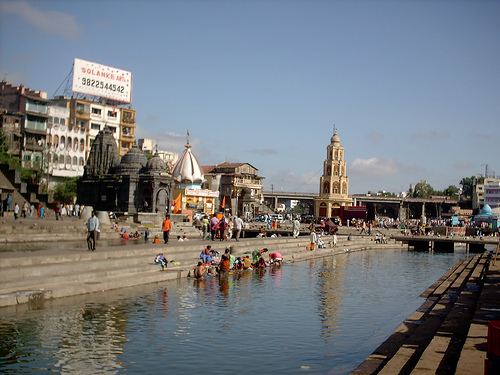
Story Related to Godavari River

Godavari River

Lord Brahma worshipped  Lord Trivikram in Satya Loka (on earth) with the same holy water of the Ganges which came from his lotus feet. He wanted to get the river Ganges to come in the material realm and that Lord Shankar should hold it on his head, to flow. Brahma’s benediction was fulfilled. However seeing river Ganges in the form of a woman closely associating  her husband Shankar,  Parvati was unhappy. She planned to drive Ganges away from her husband.

As part of the plan Parvati and her son Ganesh came to live in Gautama’s Ashrama with Parvati’s friend Jaya. There was a famine of 24 years and people were affected by the pangs of hunger. However, Varun – the God of Rains, pleased with Sage Gautama arranged rains every day  in Gautam’s Ashrama (dwelling place) which was in Trimbakeshwar. Gautama used to sow rice in the surrounding fields of his Ashrama in the morning, reap the crop in the afternoon and with it fed a large group of rishis, who took shelter in his Ashrama on account of the famine. The blessings of the group of rishis increased the merit (Punya) of Gautam. Lord Indra’s position became shaky  because of his increased merit. So Indra ordered clouds to rain all over Trimbakeshwar, so that the famine will be over and rishis will go back and the increasing merits of Gautam will be weakened. Although the famine was over, Gautam urged the rishis to stay back and kept on feeding them and gaining merit.

However Once he saw a cow grazing in the paddy field  and he drove her away by throwing Darbha (sharp, pointed grass). The slender cow died by this. It was Jaya – Parvati’s friend, who had taken the form of a cow. This news upset the Rishis and they refused to luncheon at his Ashram. Gautam requested Rishis to show a way out of this sin.

He was advised to approach Lord Shiva and request him to release Ganges and a bath in the Ganges would set him free of his sins. Gautam then practiced penance by going to the peak of Brahmagiri. Lord Shankara was pleased by his worships and gave him the Ganges.

However, Ganges was not prepared to part with Lord Shiva, which irritated him. He made Tandav Nrutya (dance) on the peak of Brahmagiri  and dashed his jata there. Frightened by this action, Ganges appeared on Brahmagiri. Later on Ganges appeared in the Trimbak Tirtha. Gautam praised her but she off and on appeared on the mountain at various places and disappeared in anger.

Gautama could not bathe in her waters. Ganges then appeared in Gangadwar, Varaha-tirtha, Rama-Laxman tirtha, Ganga Sagar tirtha. Still Gautama could not bathe in her waters. The Gautama surrounded the river with enchanted  grass and put a vow to her.  The flow stopped there and the tirtha thus came to be called Kushavarta.  It is from this Kushavarta that the river Godavari flows up to the sea. The sin of killing a cow by Gautama was wiped off here.
Dwarka Fifty Centuries Ago

The following description of Dwarka during Krishna's presence there appears in the Srimad-Bhagavatam (10.69.1–12) in connection with the sage Narada’s visit.
The City Was Filled with the sounds of birds and bees flying about the parks and pleasure gardens, while its lakes, crowded with blooming indivara, ambhoja, kahlara, kumuda, and utpala lotuses, resounded with the calls of swans and cranes.
Dwarka boasted 900,000 royal palaces, all constructed with crystal and silver and splendorously decorated with huge emeralds. Inside these palaces, the furnishings were bedecked with gold and jewels.
 
Traffic moved along a well laid-out system of boulevards, roads, intersections, and marketplaces, and many assembly houses and temples of demigods graced the charming city. The roads, courtyards, commercial streets, and residential patios were all sprinkled with water and shaded from the sun’s heat by banners waving from flagpoles.
 
In the city of Dwarka was a beautiful private quarter worshiped by the planetary rulers. This district, where the demigod Visvakarma had shown all his divine skill, was the residential area of Lord Hari [Krishna], and thus it was gorgeously decorated by the sixteen thousand palaces of Lord Krishna's queens. Narada Muni entered one of these immense palaces.
 
Supporting the palace were coral pillars decoratively inlaid with vaidurya gems. Sapphires bedecked the walls, and the floors glowed with perpetual brilliance. In that palace Tvasta had arranged canopies with hanging strands of pearls; there were also seats and beds fashioned of ivory and precious jewels. In attendance were many well-dressed maidservants bearing lockets on their necks, and also armor-clad guards with turbans, fine uniforms, and jeweled earrings.
 
The glow of numerous jewel-studded lamps dispelled all darkness in the palace. My dear king, on the ornate ridges of the roof danced loudly crying peacocks, who saw the fragrant aguru incense escaping through the holes of the latticed windows and mistook it for a cloud.

Caitanya Mahaprabhu’s Visit to Pandharpur

Chaitanya Mahaprabhus Visit to Pandharpur

Lord Caitanya visited Pandharpur while on a journey through South India, apparently to search for His sannyasi brother, Sankararanya, formerly known as Visvarupa.
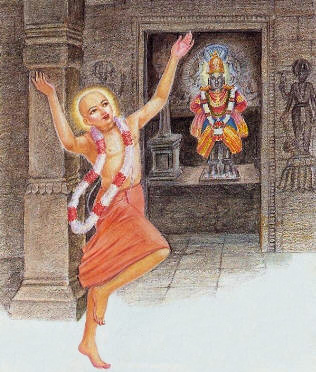
After travelling down the east coast of India through the province of Tamil Nadu and up the west coast through Kerala and Karnataka, Caitanya Mahaprabhu entered Maharashtra. As stated in the Caitanya-caritamrta (Madhya 9.282–283), the Lord went to Pandharpur, where He happily saw the Deity of Lord Vitthala and chanted and danced.
In Pandharpur, Lord Caitanya met Sri Ranga Puri, a Godbrother of His spiritual master, Isvara Puri. They talked about Lord Krishna continuously for five to seven days.
Sri Ranga Puri recalled that he had once been to Navadvipa, Lord Caitanya’s birthplace, where he had visited the house of a brahmana named Jagannatha Misra. Sri Ranga Puri remembered the taste of a curry cooked from banana flowers by Jagannatha Misra’s wife. Jagannatha Misra’s eldest son had accepted the renounced order. Sri Ranga Puri had later learned, he said, that this son had passed away in Pandharpur.
Jagannatha Misra, Lord Caitanya then revealed, had been His father, and the son who had passed away had been His brother.
Lord Caitanya stayed four more days in Pandharpur, before moving on. During His tour of South India, Lord Caitanya was constantly on the move, but He stayed in Pandharpur for about eleven days. His pastimes there, and those of His brother, establish yet another link between Pandharpur and the Gaudiya Vaisnava tradition followed by the present-day Hare Krishna devotees.
Lord Chaitanya stayed in Pandharpur for eleven days.
In Sri Caitanya-caritamrta Madhya Lila, Chapter 9, we read about Lord Caitanya’s visit to a famous Krishna temple in Maharashtra state:
Madhya 9.282
 tatha haite pandarapure aila gauracandra
 viththala-thakura dekhi’ paila ananda
“From there Sri Caitanya Mahaprabhu went to Pandarapura, where He happily saw the temple of Viththala Thakura.”
PURPORT
 The city of Pandarapura is situated on the river Bhima. It is said that Sri Caitanya Mahaprabhu initiated Tukarama when He visited Pandarapura, and thus Tukarama became His disciple. Tukarama Acarya became very famous in the Maharashtra province, and he spread the sankirtana movement all over the province. The sankirtana party belonging to Tukarama is still very popular in Bombay and throughout the province of Maharashtra. Tukarama’s book is known as Abhanga. His sankirtana party exactly resembles the Gaudiya-Vaishnava sankirtana parties, for they chant the holy name of the Lord with mridanga and karatalas.
Later in Madhya Lila 9, we find further information about Lord Caitanya’s association with Pandarapura, this time in relationship with His brother Vishvarupa : 
Madhya 9.300 
 ei tirthe sankararanyera siddhi-prapti haila
 prastave sri-ranga-puri eteka kahila
“Sri Ranga Puri informed Sri Caitanya Mahaprabhu that the sannyasi named Sankararanya had attained perfection in that holy place, Pandarapura.
PURPORT
 Sri Caitanya Mahaprabhu’s elder brother was named Visvarupa. He left home before Sri Caitanya Mahaprabhu and accepted the sannyasa order under the name of Sankararanya Svami. He travelled all over the country and finally went to Pandarapura, where he passed away after attaining perfection. In other words, he entered the spiritual world after giving up his mortal body at Pandarapura. Sri Ranga Puri, a disciple of Sri Madhavendra Puri and godbrother of Isvara Puri, disclosed this important news to Sri Caitanya Mahaprabhu.
Madhya 9.301 
 prabhu kahe,—-purvasrame tenha mora bhrata
 jagannatha misra—-purvasrame mora pita
Sri Caitanya Mahaprabhu said, “In My previous asrama, Sankararanya was My brother and Jagannatha Misra was My father.”
Madhya 9.302 
 ei-mata dui-jane ista-gosthi kari’
 dvaraka dekhite calila sri-ranga-puri
After finishing his talks with Sri Caitanya Mahaprabhu, Sri Ranga Puri started for Dvaraka-dhama.
Madhya 9.303 
 dina cari tatha prabhuke rakhila brahmana
 bhima-nadi snana kari’ karena viththala darsana
After Sri Ranga Puri departed for Dvaraka, Sri Caitanya Mahaprabhu remained with the brahmana at Pandarapura for four more days. He took His bath in the Bhima River and visited the temple of Viththala.”